Tracing Emotional Tides — A Conversation with Suzanne Barrett
As an abstract landscape artist inspired by nature and emotional memory, I’m always curious about the stories behind other artists’ work. Through this interview series, I connect with contemporary artists whose practices explore landscape, emotion, and personal narrative.
In this conversation, I speak with coastal painter Suzanne Barrett, whose expressive seascapes capture movement, memory, and the quiet pull of the ocean.
There are artists who paint what they see, and then there are artists who paint what we feel. In this conversation, I speak with coastal painter Suzanne Barrett, whose expressive works explore memory, movement, and emotional connections to the shoreline.

Can you share your journey into art and how your practice has evolved over time?
Suzanne:
I grew up with a passion for art, starting with watching Play School as a young girl and wanting to participate in their art sessions to having an inspirational Yr11 art teacher who encouraged me to go to art school. I completed my bachelor and visual art teaching degree and majored as an interdisciplinary artist working across photography, printmaking and installation.
I’ve come back to painting later in life as it allows me to express my current direction. Drawing has always been the foundation of my work, and now I’m moving into a more gestural drawing style in paint — capturing movement, especially along the coastline
You studied Fine Art and Visual Arts education — how has that influenced your creative process?
Suzanne:
Studying and teaching art gives you confidence to trust your process and push ideas through even when they feel uncertain. Teaching also inspires me creatively. I don’t think artists ever stop learning.
After stepping away from full-time teaching to raise a family, what inspired you to return to your practice with renewed focus?
Suzanne:
I was considering going back to teaching and as I moved towards doing this I kept coming back to my own artistic practice and that ‘what if’ moment. I decided to give myself a 5yr plan to build my art practice and see if I could go somewhere with it. If it didn’t succeed then I would go back to a teaching position. Three years in and I am happy with the goals I have
achieved so far. I feel like I made the right decision.


What draws you most to seascapes and coastal narratives as a recurring theme in your art?
Suzanne:
I great up in Perth, where the beach is only 20 minutes away and I have always had a love of the ocean. I always talk about moving to the beach again one day and I think this shapes my art practice. That solace of salt water that so many of us seek each time we go on a beach holiday. Living by the bay and being by the water definitely shapes my work also. The
ocean and sky and its constant movement fascinates me.
Your practice centers on mixed-media drawing and painting—can you describe your process from concept to finished artwork?
Suzanne:
As a general rule I go out and sketch in plain air and take photos before bringing it back to the studio. Sometimes this is enough to start work on canvas and other times I push the drawings further or work on composition to bring a few ideas into one. Drawing is the basis to all of my artworks, even if just a pen on napkin sketch of ideas, and I love being able to see big gestural marks in both drawing and painting. I am trying to bring more of this into my finished work. I often work oil over acrylic and sometimes oil stick over acrylic, it just depends on what feels right at the time but I love the layering process. Lately I have been painting over old work and I love the texture it brings so have also been adding a paint medium to new canvas to try and create the same texture.
How do you approach color, gesture, and layering to create atmosphere in your paintings?
Suzanne:
I can’t remember who said it, but I remember an artist saying you have to look for colour in the landscape. The colours of the landscape aren’t just greens, browns and blues. So I taught myself to look for colour. I mostly see pinks and variations of yellow where others might not. Other times I may substitute a colour like pink or blue for a brown in the landscape to give it more visual interest. Not everyone likes pink, however, and I try hard
not to use it in every work but sometimes it will still creep back into my palette. I literally see it everywhere! I work in layers of paint, usually working fat over lean like we are taught to do in oils. I will also often work oils over acrylic when trying to get more colour saturation and depth. I like to see the gestural marks and some of my best work is done alla prima with a limited palette, almost like a sketch but in paint on a canvas or board. The
looseness achieved painting this way gives a result that is similar to what our eyes see when watching the wind whip the clouds and waves along on the ocean, the landscape changing before our eyes as it shifts and moves.
You describe painting as a way of tracing emotional tides. What
emotions do you hope viewers feel when engaging with your work?
Suzanne:
I hope that viewer feel their own intrinsic emotions when looking at my work. Memory. It is different for everyone, depending on how they remember a similar scene. How they would feel when standing on the edge looking out at the water while on a beach holiday, on a dog walk, a trip away etc. That solace of salt water, that movement before our eyes, that
memory.
How do you balance abstraction and representation in your landscapes?
Suzanne:
I don’t have the patience to be a realist painter. I have more patience to take a series of photos rather than recreate a scene in paint exactly as I saw it. Instead I try to capture a feeling, the movement of the landscape, making my work less representational and more intuitive. They are often based off my memory of a place and photos I took while standing there myself. I want it to look like a seascape, but not a specific beach or place. I
leave that up to the viewer to interpret.

What role does intuition play in your creative decisions?
Suzanne:
I like to tell a narrative with my work and this is why I often work in a series. Sometimes it starts with a title, sometimes a feeling and sometimes a story. Intuition comes in while painting. I start with an idea and sometimes that leads into something else as I paint. But I am always thinking of that starting point and how this new direction relates. It all ties back together and I hope that comes across to the viewer.
You’ve been a finalist in several exhibitions and art prizes—how have these experiences shaped your confidence and career direction?
Suzanne:
I have been very fortunate to have been a finalist in quite a few art prizes. But don’t get me wrong, I have had my fair sure of rejections also. Art Prizes are a good way to see if your work is heading in a direction that compliments a gallery. I don’t take it personally if I don’t get selected, you don’t always know what the gallery is looking for. When I was starting out I entered everything I could and have probably had way more rejections than
acceptances but I then started to set goals and work towards specific art prizes that aligned to my work. I think this helped me succeed.
What has been a particularly memorable exhibition or milestone for you so far?
Suzanne:
Recently being named one of “6 Emerging Coastal Artists To Follow on Bluethumb” was pretty amazing. Winning the seascape category in the 2025 Queenscliff Art Prize was a highlight also. Being recognized in these ways helps me feel like I am on the right track with how my work is progressing.
What do you hope collectors and viewers take away from your artworks?
Suzanne:
I hope when they look at my work on the wall they are taken back to a holiday or time spent on the beach. The memories. The feeling, That solace of salt water. As humans we are drawn to the water and its healing properties. I hope this draws them to my work in the same way.
How has social media and online galleries influenced your artistic reach and connection with audiences?
Suzanne:
When I finished art school there was no such thing as social media or online art gallery platforms. You had to take a folio of work around to physical galleries and hope they would take you on as an artist. It was much harder than it is today. I love that we have social media platforms and art platforms so that it opens it up to all artists to sell their work to a much wider audience. Social media helps collectors get a better understanding of an artist and the work they are selling. You get to see the behind the scenes that you wouldn’t otherwise see in a gallery. We are very fortunately to have this online presence, both as artists and art collectors.
What inspires you creatively outside of art (books, travel, nature, music)?
Suzanne:
Definitely nature. Just being outside, there is inspiration everywhere. I like to walk and observe and just be. Also during car rides. I get inspired watching the landscape move past me as I travel from place to place.
What advice would you give emerging artists who are returning to their practice after a break?
Suzanne:
Give yourself some kindness and time to create. Set achievable goals for the year and don’t be in a rush to get where other artists might already be. You can’t rush the process. Try and create as much as you can and try and apply to lots of gallery call outs, art prizes etc. and just get your work out there. But don’t let rejection feel like failure, it’s a chance to grow and learn. Celebrate the small achievements, they will eventually lead to bigger achievements. And never stop learning.
How do you stay creatively motivated during quieter or challenging periods?
Suzanne:
I allow myself permission to take breaks when I need it or when I am not feeling creative. The creative process can’t be forced or rushed, otherwise nothing turns out as planned and I get frustrated. If I am not creating then I will go to galleries or follow what other artists are doing. I regularly take online or in person art classes as I love learning new creative processes. We never stop learning and growing as a creative.
What themes or directions are you excited to explore in your future work?
I am currently looking at movement, wanting to try and push drawing into the paint medium. Big gestural marks, to see the mark making in the finished painting. I also did a lot of printmaking at Uni and would love to incorporate it into my painting practice somehow. I have seen many artists do this successfully so I would love to explore this further when I get the opportunity.
Are there any upcoming projects or exhibitions you’re looking forward to?
Suzanne:
I am taking this year to focus on continuing to create a body of work and to also work much larger. I have deliberately decided not to apply to any new art galleries, art prizes or exhibitions this year as they tend to take your time and focus away from what you are working on, so this is my year to just focus on my artistic practice in the studio.
Quick Fire Questions
Favourite palette?
All the blues. With a dash of pink. I try not to use pink but it usually always creeps into my work, either as the base layer or as a final highlight.
Favourite place to paint?
NSW beaches have been a favourite of late, just driving down the coast and seeing where it leads me.
One word to describe your art?
Coastal.
Studio soundtrack?
I listen to Talking With Painters podcast or Triple J. I have been listening to Triple J since I was 16 and it still inspires me.
Where to Find Suzanne’s Work
Follow Suzanne Barrett On Instagram
Buy Suzzanne's Artwork on Bluethumb
About the Interviewer
This interview is part of an ongoing artist conversation series hosted on my website, where I share insights from contemporary artists exploring landscape, abstraction, and emotional storytelling through art.
If you’d like to explore more artist interviews, studio insights, and my own abstract landscape works, you can visit:
👉 Alpana Rai Arts
Explore Alpana Rai’s Art
Discover colourful original abstract landscape paintings and fine art prints by Melbourne artist Alpana Rai, inspired by Australian landscapes, memory and emotion.
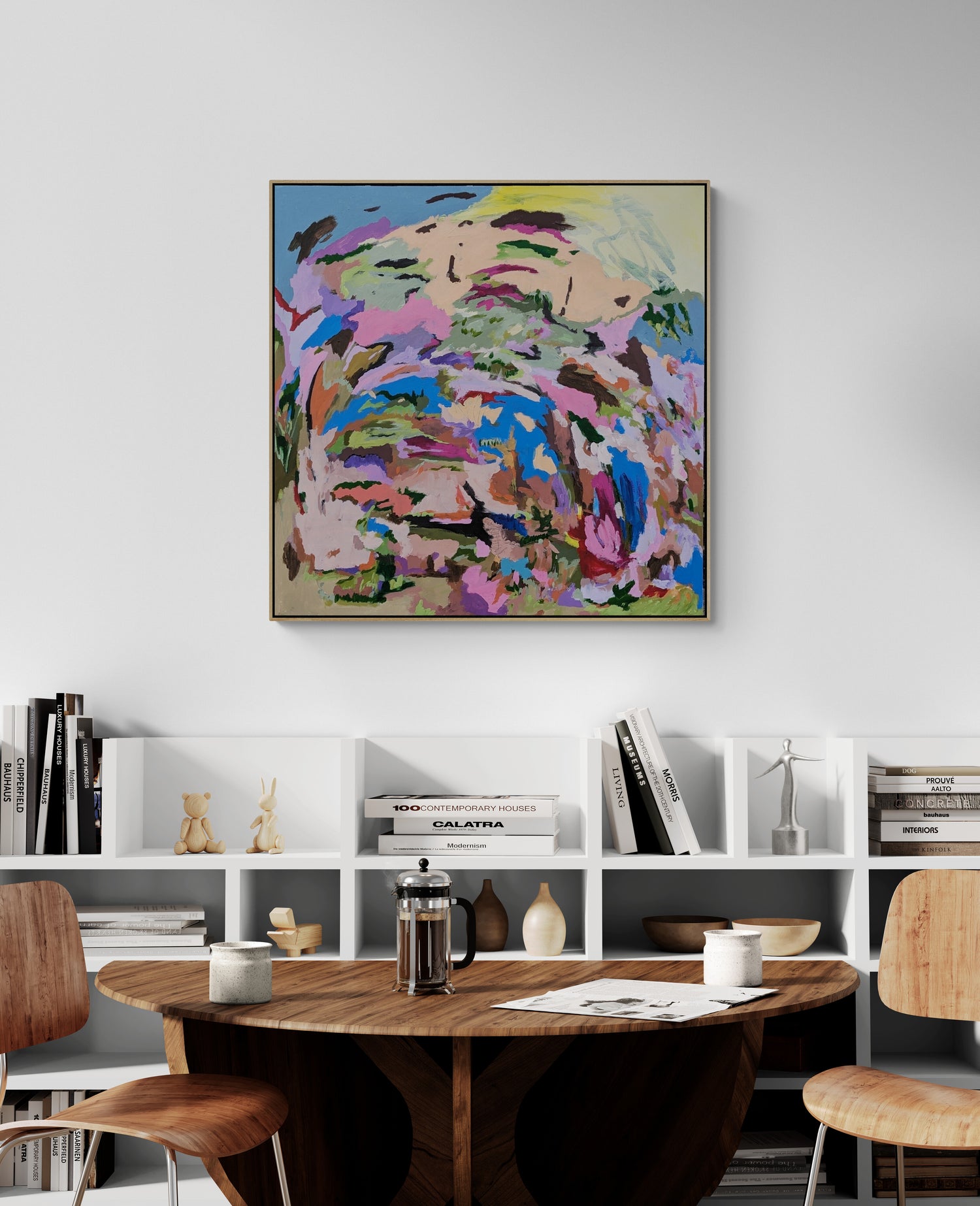
" WHERE YOU FIND ME" Available via The Toowoomba Gallery
$1600
103 x 103cm. Acrylic on canvas, framed in natural oak.